


Asahi-sha: Architectural and Woodworking Wonders
The Asahi no Yashiro, or Asahi-sha, is a subsidiary shrine at Kotohiragū and an Important Cultural Property. The wooden building stands 25 meters high, and its complex construction took nearly 40 years. About 138,000 people from around the country helped fund the massive undertaking.
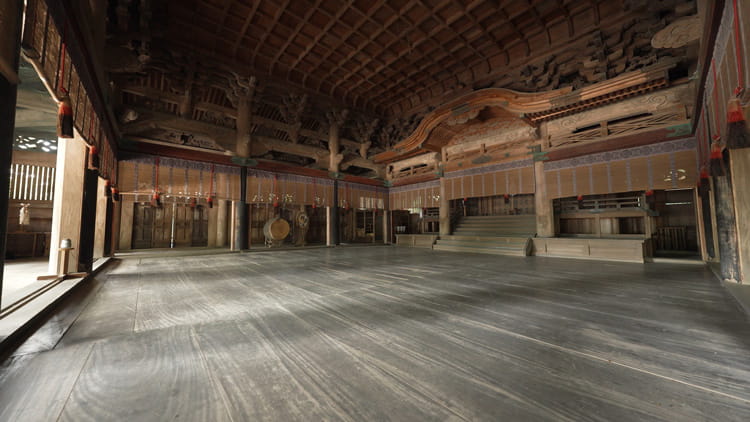
A Transformed Hall
When it was first built, Asahi-sha enshrined a large Buddhist statue in the main chamber on the first floor. In other styles of temple architecture, the principal statues are commonly surrounded by pillars that hold up the high ceiling. However, Asahi-sha was designed without central pillars, creating a wide-open space with an unblocked view of the object of worship. This was achieved thanks to a cantilevering system concealed in the upper story, as well as a series of architectural features around the periphery of the main chamber that help transfer the weight of the roof. Weight-bearing bracket complexes near the ceiling are supported by columns around the edges of the chamber, and these columns are connected by a series of horizontal beams.
In comparison to Buddhist halls, which enshrine statuary, Shinto halls commonly have an elevated inner sanctum that provides a concealed place for the kami to reside. When Kotohiragū became an exclusively Shinto shrine in 1868, Asahi-sha’s Buddhist statue and the platform it stood on were removed, and a Shinto-style inner sanctum was installed at the rear of the hall.
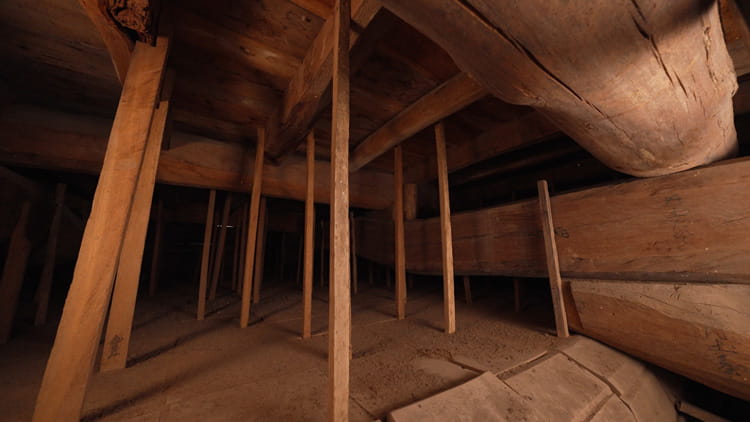
There are signs of this transition around the inner sanctum. The pillars on either side of its steps stand at the periphery of where the original dais was, and they have sections of wood that were cut away to make room for it. Another sign can be found in the artwork. The hall’s original design included carvings of the 12 Chinese zodiac animals between the horizontal beams surrounding the main chamber, but a careful count shows only 11. The missing animal (the rooster) was replaced by the roof of the inner sanctum and is stored in the attic.
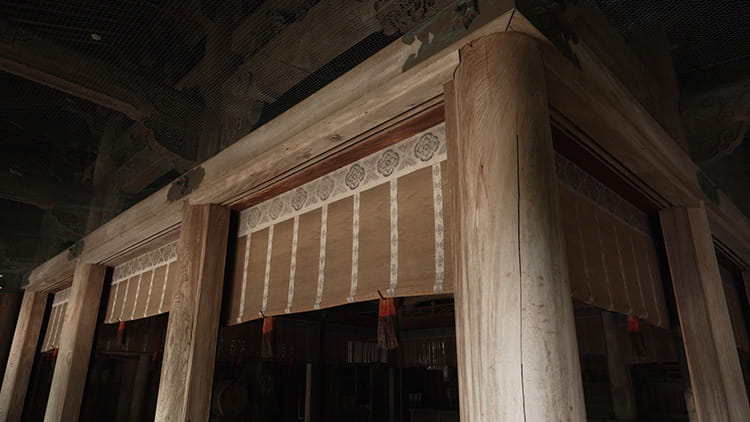
Precious Zelkova Wood
Most of the structure is built from high-quality zelkova wood. The strength and pest resistance of this finely grained hardwood make it an advantageous building material, and no expense was spared in sourcing Asahi-sha’s zelkova. More than a hundred logs from ancient trees were transported by boat from faraway Akita Prefecture, in northern Japan. After arriving at the port, the massive logs had to be carried up the mountain to the building site.
A Rare Double Roof
Asahi-sha has two hip-and-gable roofs, with the upper roof 10.5 meters higher than the lower roof. Hip-and-gable roofs, with their central ridgeline, sloping eaves on four sides, and two triangular gables on opposite sides, are common among temples and shrines across Japan. However, a double-roofed structure like this was rare in the early nineteenth century. It is supported by additional columns set on a complex of beams placed between the first-story ceiling and the second-story floor.
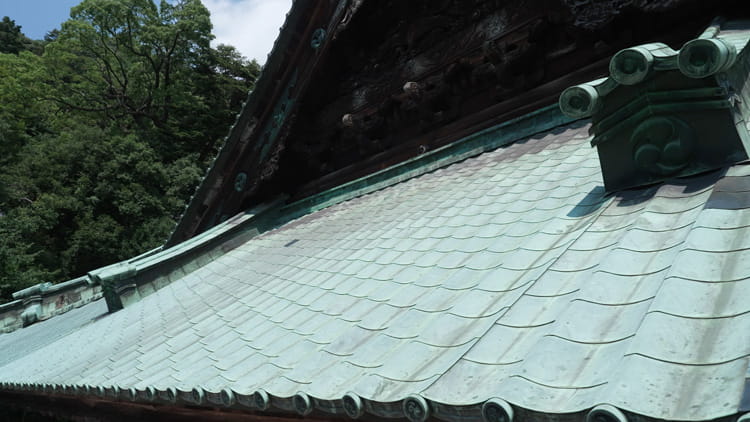
10,000 Copper Tiles
The hall was originally designed with a conventional roof of overlapping, curved clay tiles. However, they proved to be too heavy for this structure to support. The builders instead chose to use copper plates shaped to resemble the usual clay tiles. Approximately 10,000 plates were needed, and each had to be individually formed and fitted into the overlapping pattern. Over roughly 200 years, the bright orange tones of new copper have softened into a green patina.
A Delicate Balance
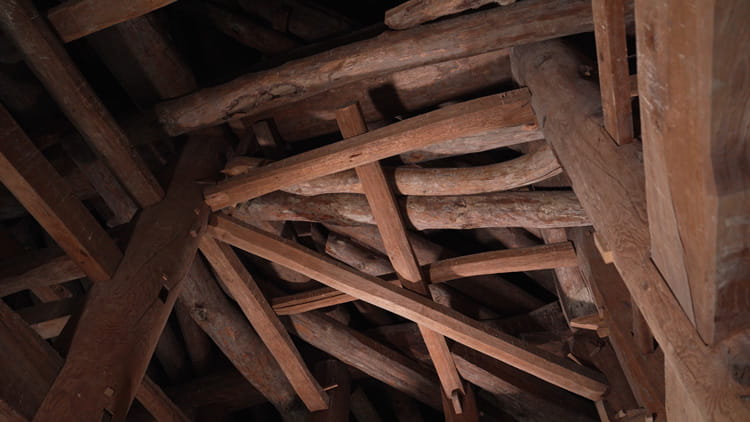
The massive, swooping eaves of the roof extend far beyond the building’s walls. Their weight is supported by long wooden cantilevers called hanegi, which are hidden in the upper story.
Inside the building, the space under the roof looks like a tangle of straight and curved beams. It is, in fact, delicately balanced. The hanegi extend from the eaves to the center of the roof. In the middle, they lie perpendicular across a horizontal beam that acts as a fulcrum. The weight of the roof presses down on the interior ends of the hanegi, levering the opposite ends upward like a seesaw. The exterior ends support the weight of the eaves, while the horizontal beam at the center of the system is supported by weight-bearing columns throughout the structure.
In contrast to the beams and pillars made from strong zelkova wood, the thinner, more flexible pine logs of the hanegi are better able to bear the shifting load of the cantilever system.
Cloud-Carved Eaves
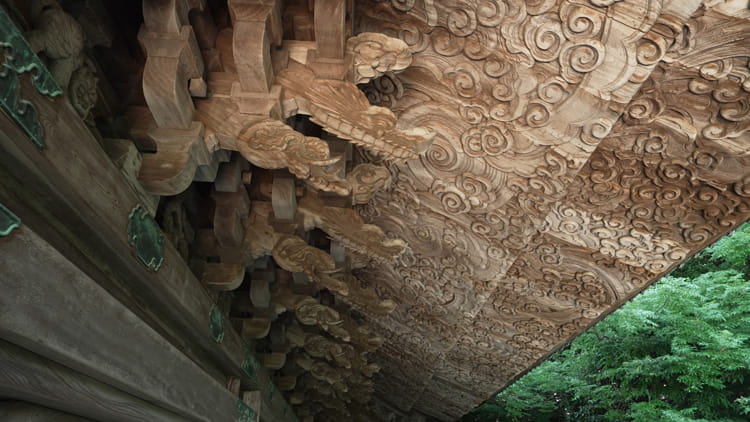
The undersides of the second-floor eaves are carved with stylized clouds. Clouds are a common motif in temple and shrine architecture, symbolically connecting earthbound structures with the heavens. The grooves in the carvings are centimeters deep, and the pattern extends to areas not visible from below. No effort or expense was spared in building the sacred site, even in places where the decorations would rarely be seen.
Animals in the Rafters
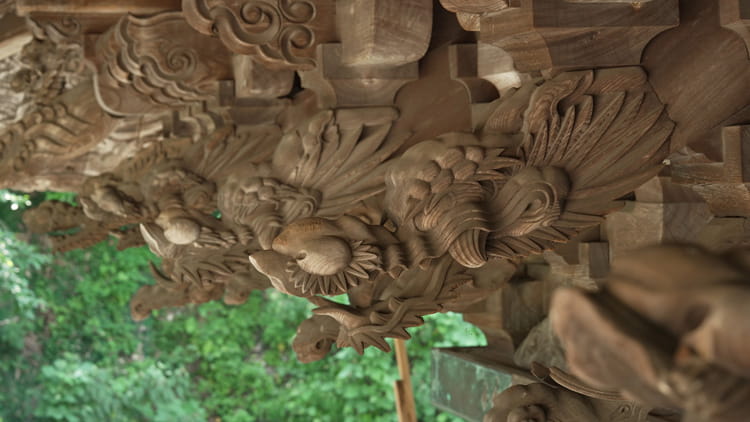
Tail rafters extend outward from the terraced brackets under the eaves. Like the hanegi that are hidden under the roof, these rafters are cantilevered like a seesaw to help bear the weight of the eaves.
As is common in Buddhist architecture, Asahi-sha has two rows of tail rafters. Both are elaborately carved. Fierce dragons are depicted on the upper row, and elephants are depicted on the lower row. Some of the creatures are depicted with their mouths open, forming the syllable a, while others have mouths closed, representing un. These are the first and last sounds of the Sanskrit syllabary as used in Japanese Buddhism, and together they symbolize beginning and ending, the cycle of life and death.
Fire-Fighting Fish and Other Animals
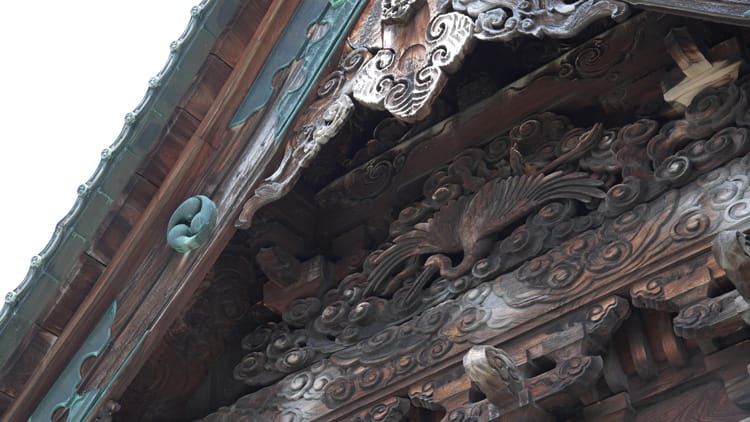
Detailed carvings decorate the exterior walls of Asahi-sha. Along the top of the walls of the first floor, for example, are depictions of different kinds of fish. These may be related to Kotohiragū’s association with the sea, or they may be intended to ward off fires. Animals and mythological creatures associated with water have long been used to decorate wooden structures as protective talismans.
A large crane is carved into one of the gables, and a large turtle decorates the other. These animals are said to live for 1,000 and 10,000 years, respectively. Cranes and turtles thus appear throughout Japanese art as auspicious symbols of longevity.
The Immortal Sages
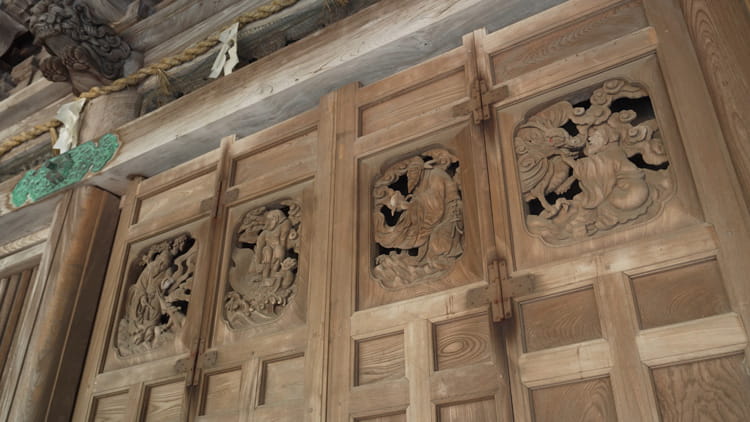
The first floor has a main entrance and two side entrances. All three sides are fitted with hinged double doors called sankarado that are typical of Zen-style architecture. At Asahi-sha, each door has an additional folding hinge in the middle, allowing it to be neatly folded in half when open. The top panels of each section have openwork carvings, and the apertures allow air and light into the interior.
In total, the panels depict 36 Daoist immortals from Chinese folklore. These immortals are a recurring motif in religious art in both China and Japan, often depicted in harmony with nature as they seek enlightenment. In transcending the mundane world, they were said to have cultivated mystical powers like the ability to fly. Their inclusion at Asahi-sha is thought to express a prayer for divine protection.
Links


令和7年度文化財多言語解説整備事業