


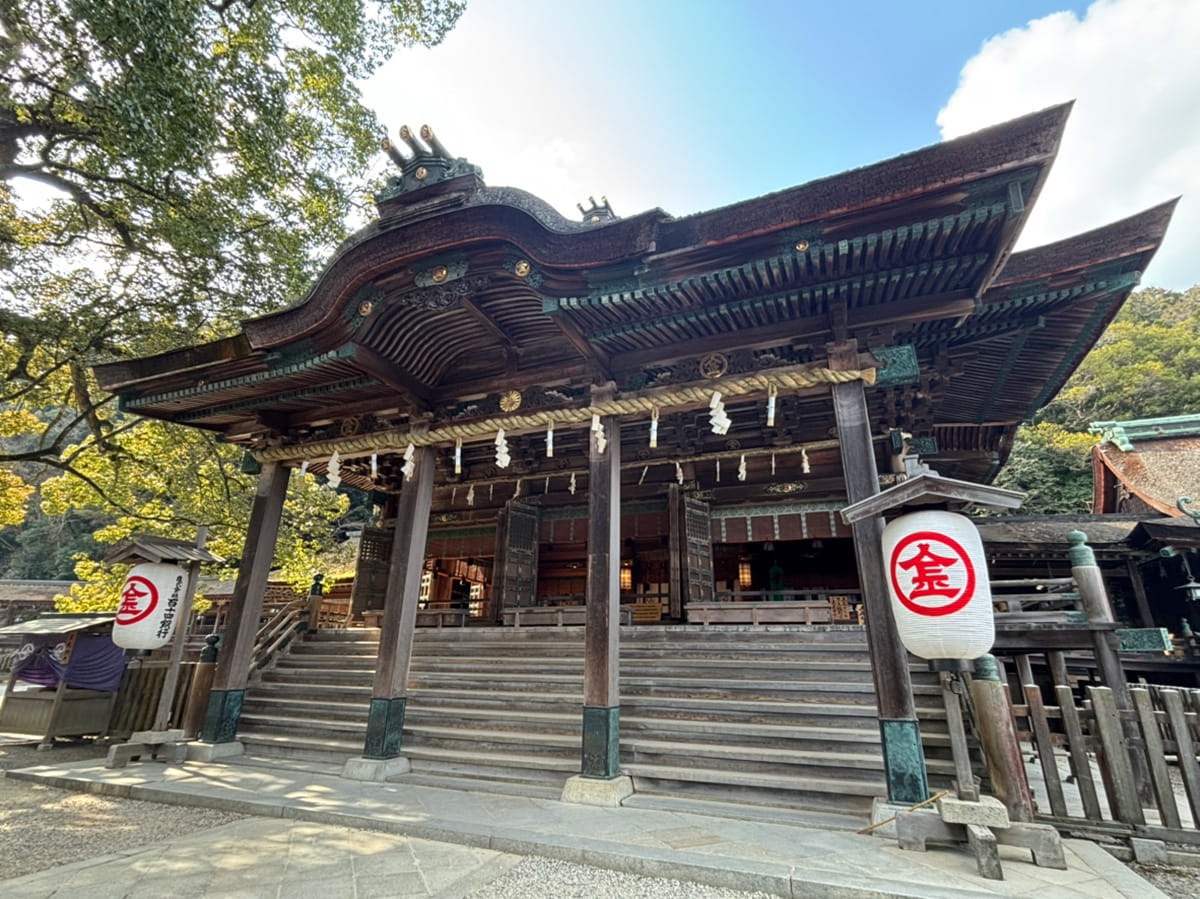
Audio Guide to the Former Konpira Grand Theater (Kanamaruza)
The audio guide below will play in the selected language
Historical Background of Kanamaru-za
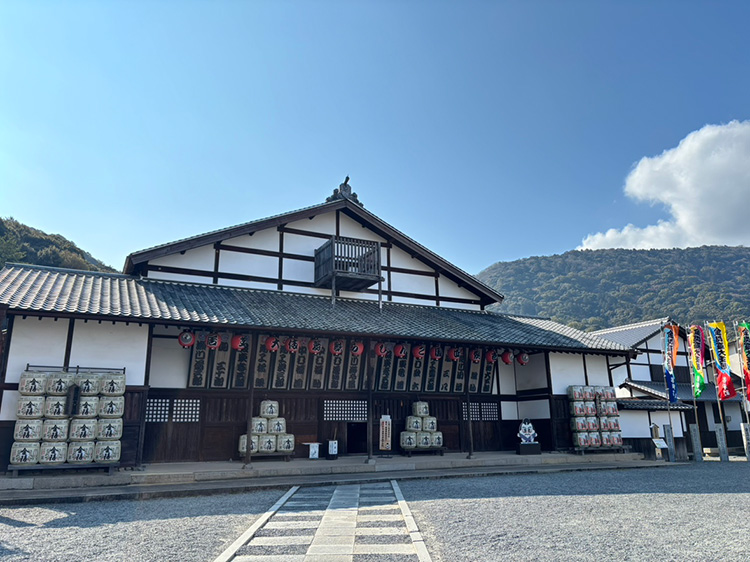
Welcome to Kanamaru-za, or the Former Konpira Grand Theater, the oldest complete kabuki theater still standing in Japan. The building dates back to 1835, and it became an Important Cultural Property in 1970, but there’s much more to the story than that.
In the 18th century or so, Kotohira-gu Shrine became a major destination for religious pilgrimages in Japan, and these crowds of travelers created demand for entertainment. A makeshift theater was built near the shrine grounds, and they held several performances a year of kabuki and other types of plays. Eventually, in 1835, a more permanent kabuki theater was constructed, named the Konpira Oshibai or Konpira Grand Theater, and in 1899 it became known as Kanamaru-za.
Seventy years later, it was declared an Important Cultural Property, and in the seventies the theater was disassembled and moved it to its current location. Finally, 2003 marked the start of further work to return it to its original 19th-century state, which you can see today. As a result, Kanamaru-za still retains many old-fashioned elements that have either fallen out of favor or been otherwise modernized at other kabuki theaters.
The theater is also still in regular use, with annual kabuki performance events in April of each year. These offer a rare opportunity to not only enjoy first-rate performers, but to experience kabuki as it existed back when it was popular entertainment for the masses, with virtually every seat offering an intimate view of the show.
The exterior of the theater features a small raised platform high up on the front wall, called the yagura. Before performances, someone would traditionally play a drum on this platform as a form of announcement, literally drumming up excitement.
And speaking of excitement, the time has nearly come for us step inside, like countless theater-goers over the decades — and in our case, we’ll be exploring the venue, stepping backstage, and even going underground.
Large Entrances and “Mouse Entrance”
Before we head inside, take a moment for a closer look at the front of the building, and see if you can identify the entrance.
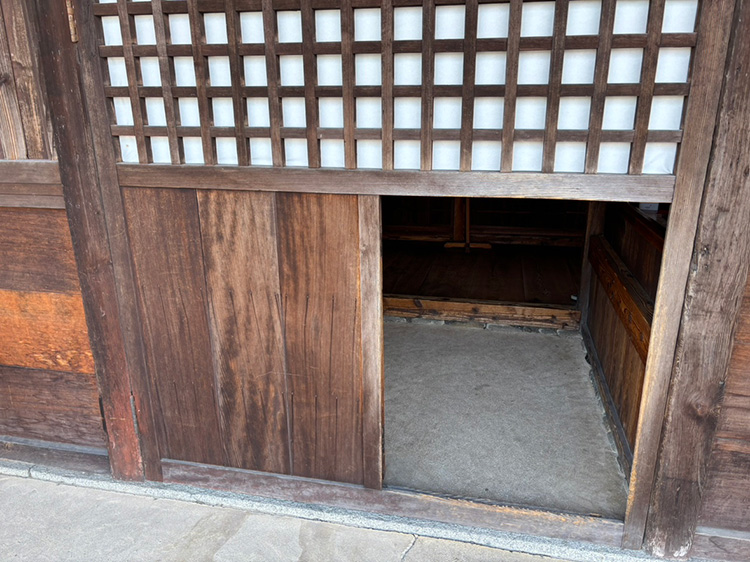
If you find yourself unsure which of these three differently sized doors was the entrance, don’t worry — all three of them were, in different ways. The ones on the sides have full-height doors, with the one on the left being for purchasers of expensive seats, and the one on the right being for people of high social status.
The central entrance, however, is noticeably smaller than the others, despite being intended for the general public. This is by design: by being forced to bend down to go through a much lower entrance, audience members effectively had to enter one by one, allowing the theater’s owners to ensure that everyone properly paid their admission fees. This entrance was called the nezumi kido, literally the “mouse entrance,” presumably in reference to how theater-goers looked as they went inside.
Ticket Sales & Footwear Attendants
Just inside the entrances is a lobby with an earthen floor. As we step into the building, imagine for a moment that it’s the middle of the 19th century, and you’re an ordinary member of the public here to see a show. You’ve just crouched down to come in through the central “mouse entrance,” and as you stand up, the ticket seller is just to your right, so you hand over your admission money.
After paying to get in, you would take off your sandals and step up onto the wooden floor, because back then, everyone simply knew that you never go inside buildings with your outdoor footwear still on. You would then pick up your sandals and take them over to a booth in one corner of the lobby, and hand them to the attendant. They would give you a numbered pickup tablet in return, which you would hold onto for later. At this point, all that would remain would be to find your seat, and wait for the show.
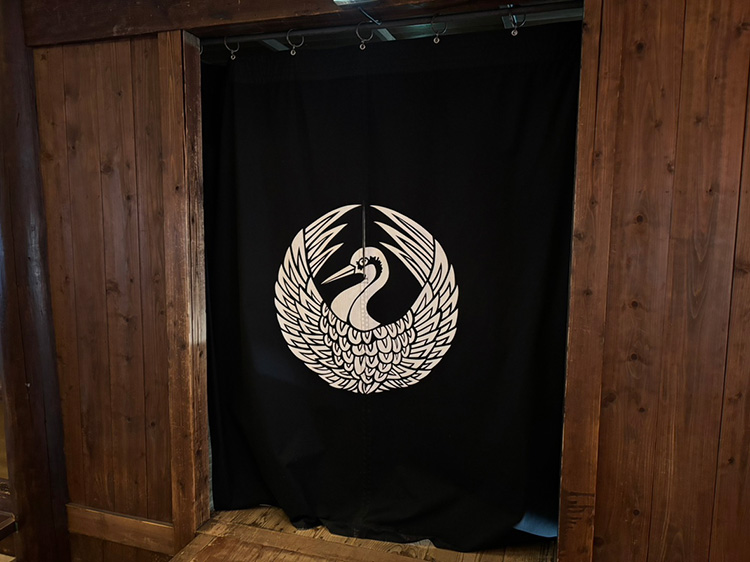
Toya
The toya is a small room in the back corner of the theater, located at one end of the hanamichi walkway. Despite its location, it is considered “backstage,” and actors can move between the toya and the main backstage area through an underground walkway. This makes it possible for actors to use it for both entrances and exits.
The curtain on the toya features a design depicting a crane, which you may have already noticed here and there around the theater — it is, in fact, the crest of the theater itself. Hidden within this decoration, too, is a small hole in the curtain, which lets actors watch for onstage cues from inside.
The curtain hangs from a rod by rings, which are more than just functional: they also produce a distinctive sharp sound when the curtain is opened quickly, drawing the audience’s attention to the back corner of the theater.
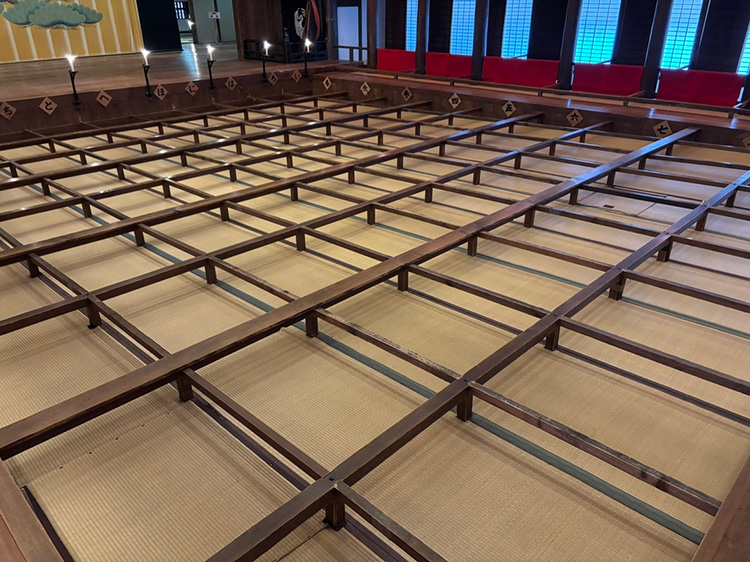
Seating at Kanamaru-za
As we enter the main hall of the theater, it may feel much like stepping back in time. This is only natural, given that Kanamaru-za was built roughly 200 years ago, and still uses essentially the same seating arrangement as it did back then.
Kabuki theaters today generally still retain certain elements of what you’ll see here, but it is extraordinarily rare nowadays to find one with everything so authentically maintained as it was in kabuki’s heyday.
The sides of the main hall feature two levels of premium-priced box seating — remember the full-height front entrance for theater-goers? — and in the rear, there are three rows of tiered bench seating located up above the lobby.
The main seating area, in the center, is a large tatami floor with rails dividing it into square sections, each of which is intended to seat up to four. There are also 15-cm-wide planks across this area, for audience members to walk along to get to their seats. The floor here is gently sloped, with the back section raised to provide a better view over the people in front.
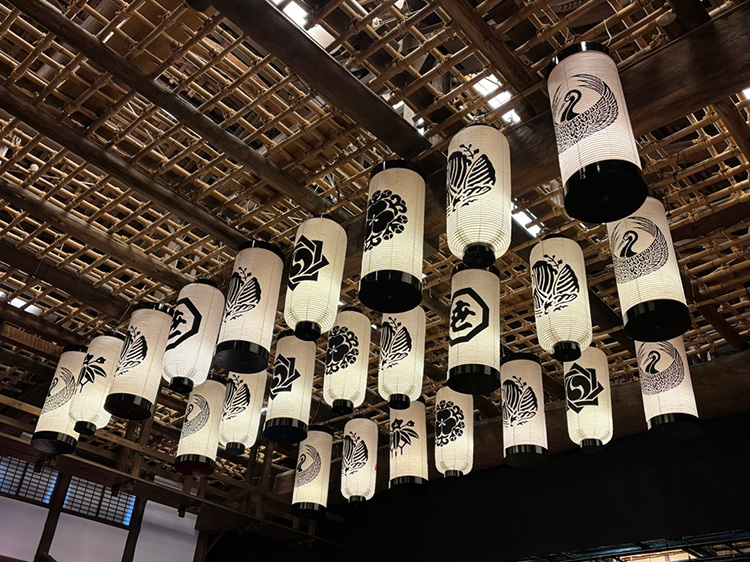
Main Hall Lanterns
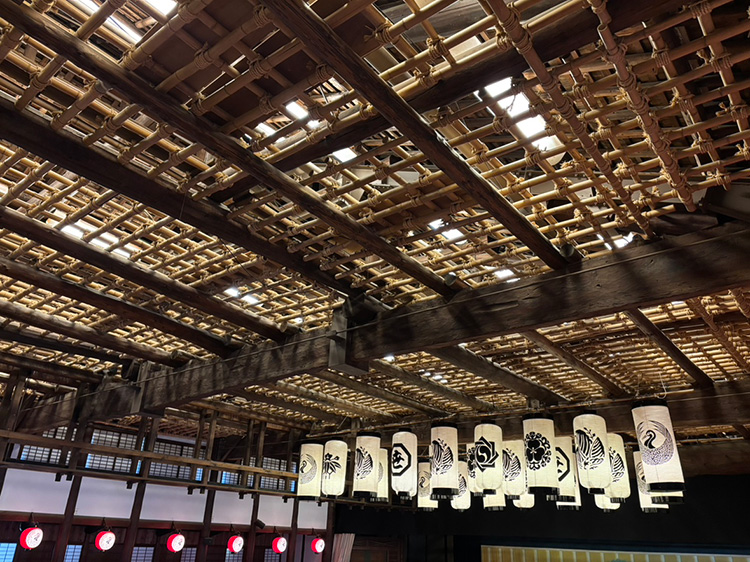
If you haven’t already, take a look up at what hangs above: the main hall features a special set of impressive white lanterns on the ceiling, each 1.2 meters tall, hanging in three rows above the front audience seats. The ones at the ends of each row feature the theater’s crane crest, while the rest show the crests of the actors involved in the day’s performance, arranged based on their ranks.
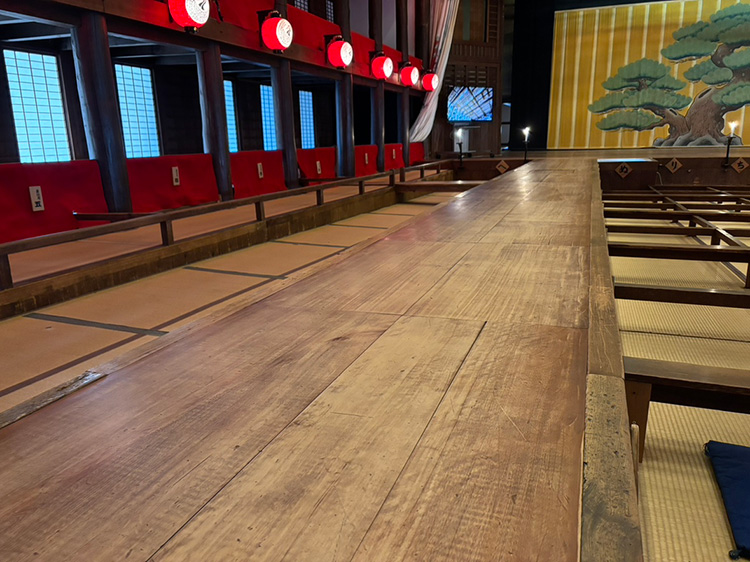
Hanamichi Walkway
One of the most distinctive features of kabuki theaters is the hanamichi, literally the “flower path.” This raised walkway runs along one side of the theater through the main seating area, to the audience’s left, connecting the stage to the back corner. Actors can use it for entrances, exits, or to establish a sense of a separate location from the main stage, in which case it can represent anything from a country road to the path through a castle, or even the sea. As you stand on the hanamachi, you may be able to get a sense for just how close it comes to much of the audience.
Depending on the dramatic effect intended, entrances and exits can use either the toya, a small curtained room in the back corner, or the suppon, a section of the floor on a platform that can be raised and lowered.
Performers can simply open the curtain to make their entrance, but often stagehands clap together two pieces of wood to make a sharp clack-clack sound, to dramatically punctuate a character entrance.
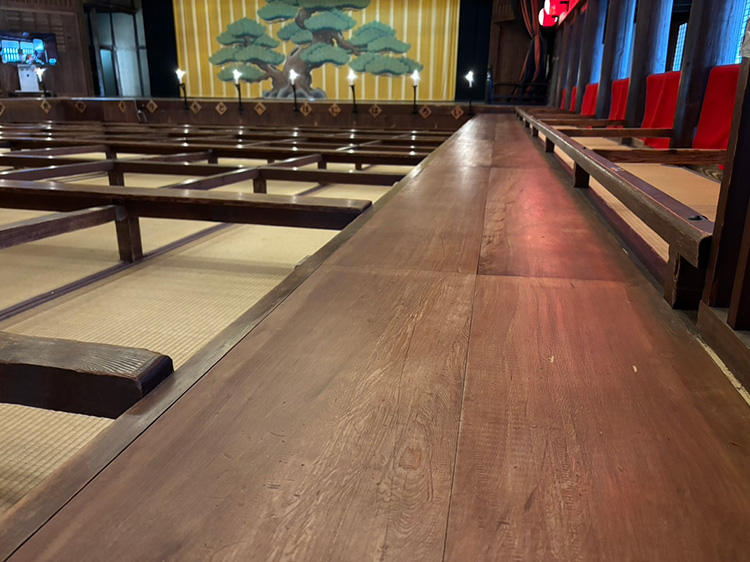
Kari-Hanamichi Walkway
The kari-hanamichi, literally the “makeshift flower path,” serves as a secondary hanamichi walkway running along the other side of the theater. As the “makeshift” in the name might imply, it was not initially intended as an extension of the stage: it was originally meant as a corridor to enable audience members to get to their seats.
Over time, though, performers began to take note of its dramatic potential, and it came to be used in plays as a secondary hanamichi. Not all kabuki theaters include this feature, but at theaters like Kanamaru-za that do, it can serve to further heighten the dramatic intensity of a show, particularly when used in parallel with the main hanamichi.
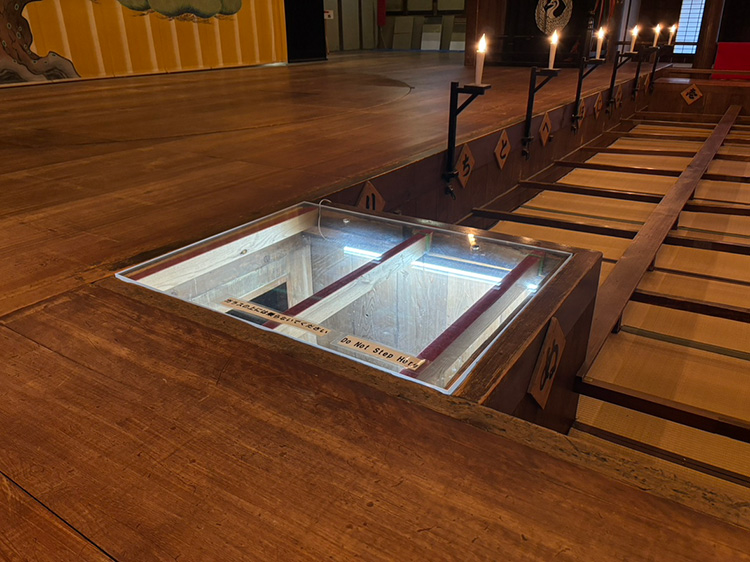
Kara-Ido “Dry Well”
The kara-ido, or “dry well,” is a square opening next to where the hanamichi meets the stage. It is kept covered when not in use, and when opened it provides access to the theater’s underground space. It can serve as a well or pond during plays, or as a way for actors to make entrances, exits, or do quick costume changes. Visitors aren’t allowed into the kara-ido, but don’t worry — we’ll be heading underground ourselves soon enough, where we’ll be able to see it from the other side.
Over the centuries, the kara-ido became less and less common at kabuki theaters nationwide. Today, Kanamaru-za is the only kabuki theater in Japan that still features one.
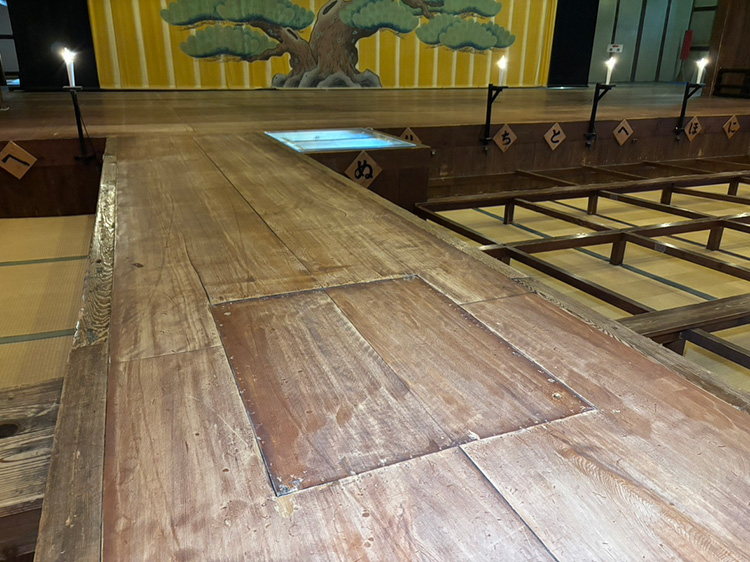
Suppon Platform
The suppon is a section of the hanamichi’s floor on a platform that can be raised and lowered. The name literally means “snapping turtle,” based on the way actors resemble a turtle’s head going into or out of its shell as they descend into the floor or come up out of it. This style of entrance or exit lends itself to supernatural characters, so the suppon is mainly used for phantoms, ghosts, and goblins.
Incidentally, the suppon at Kanamaru-za is still manually powered by people lifting or lowering the platform directly — a rarity nowadays. We’ll be seeing this platform again in a little while, but this time from below.
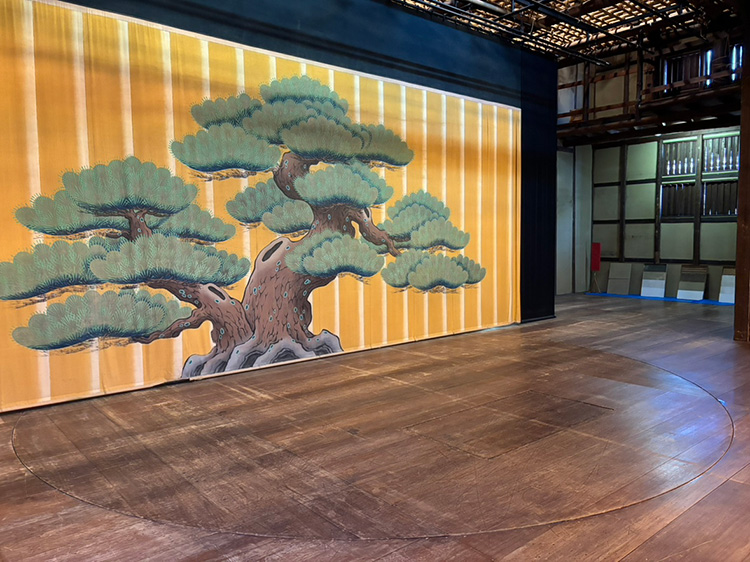
Revolving Stage
Nowadays, many people might associate revolving stages with contemporary musicals, but in fact they were actually invented centuries ago for kabuki. Like most kabuki theaters, the one here at Kanamaru-za is more than seven meters across, and can turn freely through all 360 degrees of movement. This revolving section found in kabuki stages also has an additional rising and lowering platform within it called the seri, which can be used for character entrances and exits, into or out of the stage itself.
What makes the revolving stage here at Kanamaru-za unique is the fact that it is still fully human-powered, rather than using electric motors. We’ll be heading under the stage, in fact, to see this mechanism firsthand.
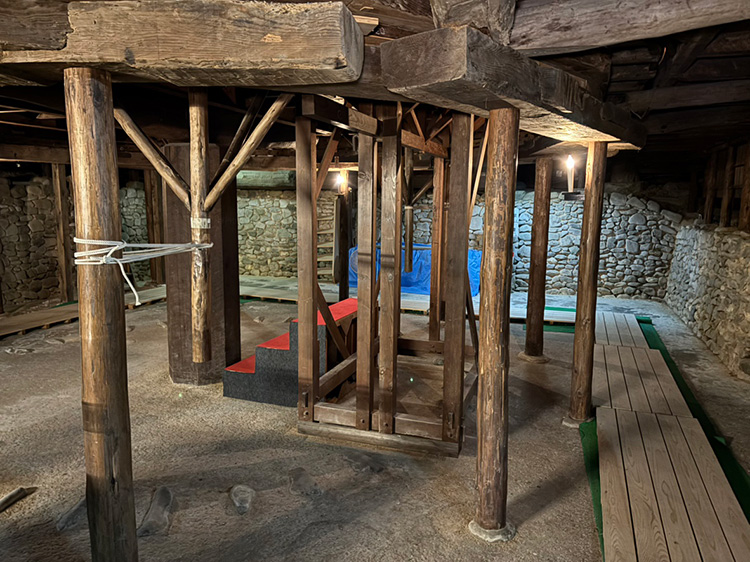
Naraku Underground Area
The underground area beneath the stage and hanamichi walkway is poetically named the naraku, after the word for the Buddhist hell. Take a moment to imagine this space without the benefit of electric lighting, and the name should feel self-explanatory.
The naraku at Kanamaru-za is two and a half meters deep, with stone walls. In addition to serving as a tunnel connecting the main backstage area with the toya room in the back corner of the theater, this is where all of the stage mechanisms are located.
Unlike most kabuki theaters today, all of the mechanisms here are still human-powered. In the center is the revolving section of the stage, with posts hanging down for people to push. Stones are embedded into the floor below, providing greater leverage for the stagehands to push against as they rotate the stage. To help make this a little easier and smoother, the revolving section of the stage actually sits on twenty-six sets of wooden roller bearings. You can even see a set of these rollers on display in the showcase by the wooden walkway.
The naraku is also where stagehands control the platforms embedded in the main stage and the hanamichi walkway, which can be raised or lowered for character entrances or exits. These too are powered entirely by human muscles.
Musical Accompaniments
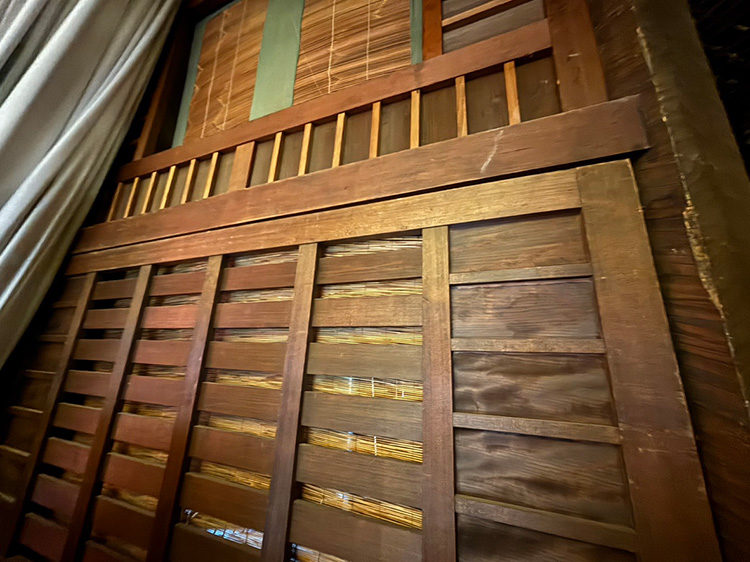
On either side of the stage, there are two-level structures for the musical accompaniments. The bottom level of each has a small room where musicians sit, largely obscured from the audience’s view by a wall with a covered gap in it.
The music of kabuki is an evolution, of sorts, of the older tradition of chanting that accompanies Noh plays. Much like Noh, kabuki uses traditional Japanese drums and flutes, but with the distinctive addition of the shamisen, a banjo-like stringed instrument with a sharp, percussive sound.
Additionally, the top level on each side is used by the vocalists who perform the chants that serve as narration during shows.
Backstage
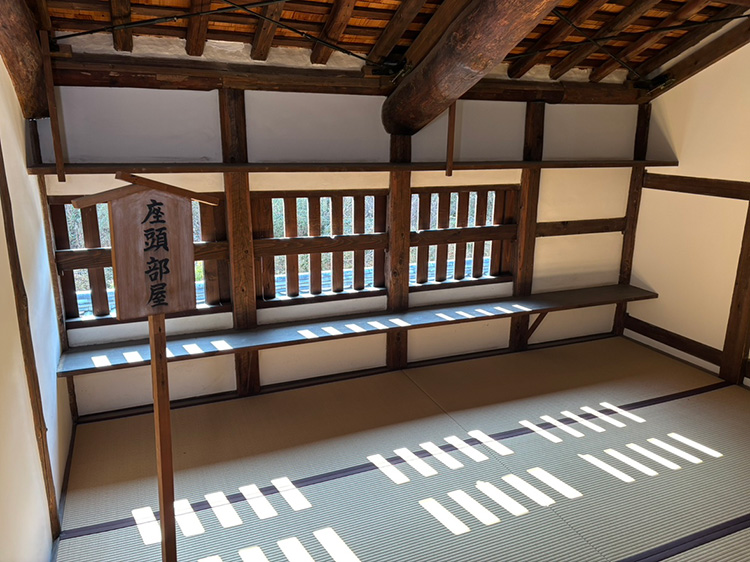
The main backstage area of a kabuki theater functions much like the backstage area of Western theaters. The rooms here offer space for actors to change and get into costume, for musicians to rest, and for hairdressers to prepare the elaborate hairstyles used onstage.
For the most part, this part of the theater remains as it has been from the start, but with one major concession to the passage of time: only the bottom floor is now in regular use. The reason why this change happened is unclear, but it is most likely due to the limited space upstairs.
Budo-dana “Grapevine Trellis” & Flying Mechanism
Let’s take another look up, but this time at the ceiling itself: this style of open framework ceiling is called a budo-dana, or literally “grapevine trellis.” It consists of 500 bamboo rods bound into a grid pattern with straw rope, and traditionally, stagehands would take advantage of the gaps in the ceiling. Depending on the play, this could mean sprinkling cherry blossom petals or paper snow over the audience, or even hanging tiny electric lights on strings to simulate fireflies.
To the audience’s left, above the hanamichi walkway, there is another mechanism in the ceiling that allowed performers to “fly” above the length of the hanamichi. They are suspended from a line hanging from the ceiling, which moves along a linear track. The device found here is noteworthy not only for its dramatic potential, but for its historical value: it is one of only a handful from the era that still remain today.
Lighting Windows
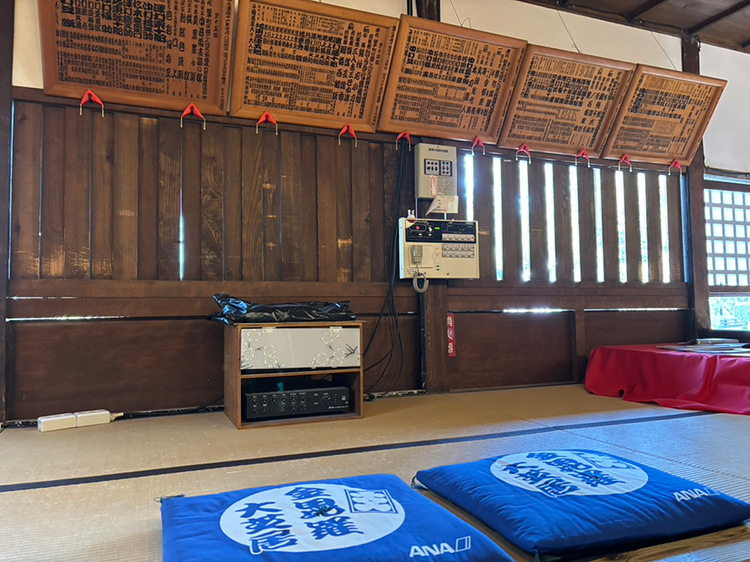
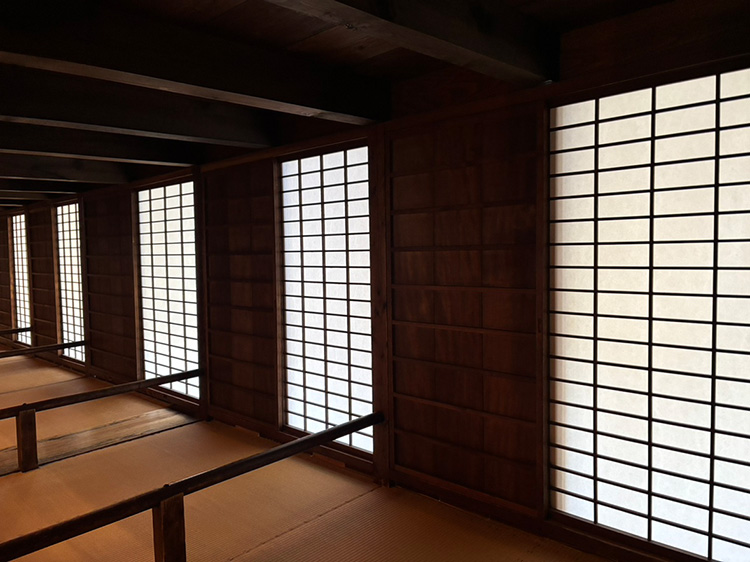
Look closely at the side walls, behind the box seating, and you might be able to see the windows and shutters. These can be opened or closed to adjust the lighting inside the theater, especially back in the days before electric lights. The windows can be covered with translucent paper screens to take advantage of natural lighting during the day — or, when the show demands, the wooden shutters can all be closed by the stagehands, plunging the entire theater into near-total darkness.
Other audio guide content
Links


令和7年度文化財多言語解説整備事業