


Kotohiragū Shrine Audio Guide
The audio guide below will play in the selected language
Introduction
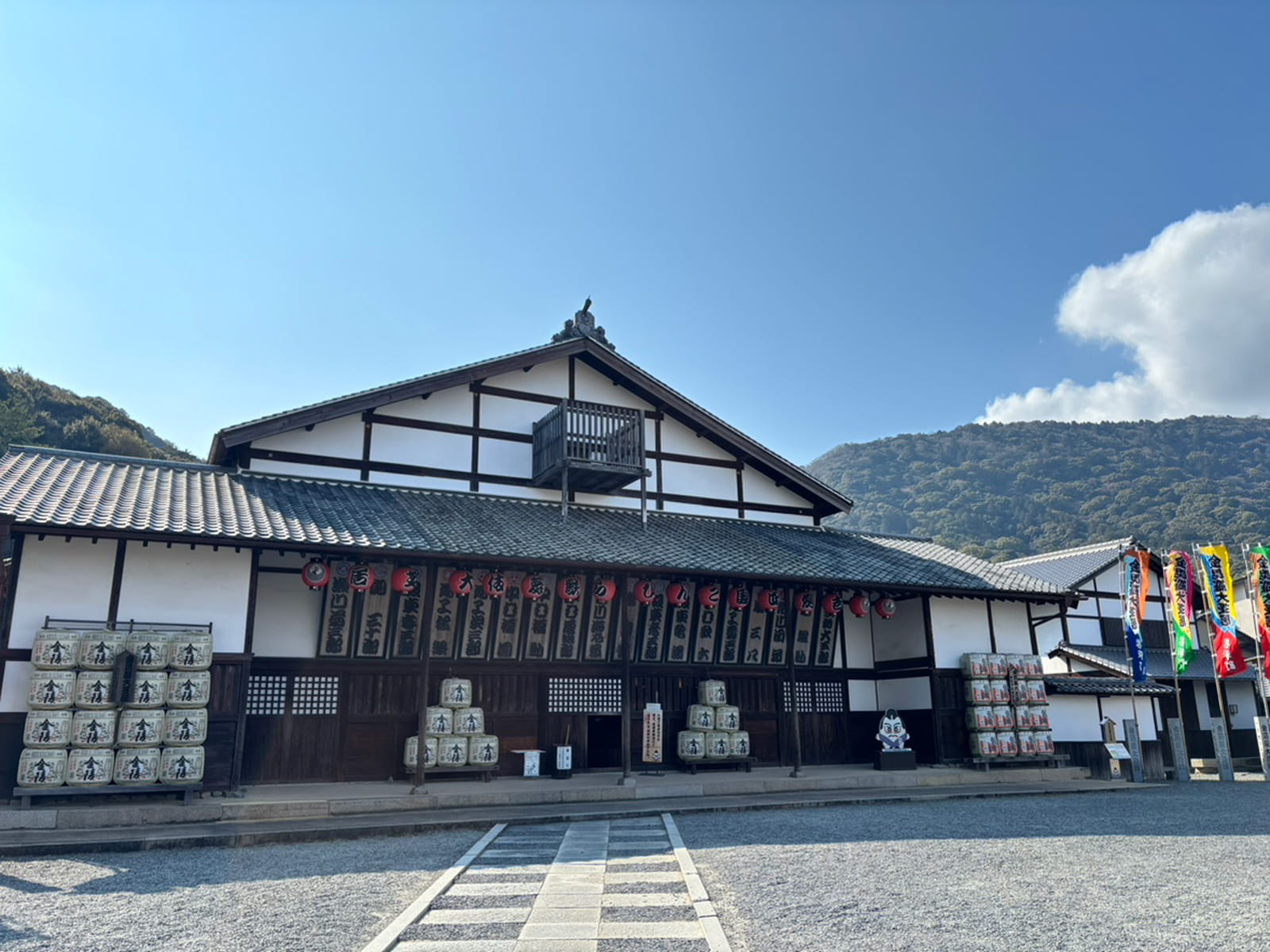
Hello and welcome. This audio guide will accompany you on your journey through the many sites of Kotohiragū Shrine, which is also known as “Konpira-san.” The shrine is located high on the eastern slope of Mt. Zōzu, a mountain named for its resemblance to an elephant’s head. Starting from the town of Kotohira, there are 785 steps to the Main Shrine. After that, another 583 steps will bring you to Izutama Jinja Shrine, which is also known as the rear shrine. It will be the final stop on today’s journey and the highest building on the shrine grounds.
There is plenty to see along the way, including museums, historical monuments, and even animals. As you climb the steps, this audio guide will play automatically when you approach places of interest.
As you begin your ascent, you are starting on a path walked by countless pilgrims before you. No one knows exactly when Konpira-san was first built, but it is thought to be as much as 3,000 years old. The shrine received many religious pilgrims from around Japan, especially between the seventeenth and nineteenth centuries, when pilgrimage was a primary reason for travel. Konpira-san has since remained a popular destination for visitors to the island of Shikoku.
Konpira-san enshrines Shinto deities called “kami.” Some kami have origins in ancient Japanese mythology, and others are the spirits of natural phenomena or even historical figures. The kami in Konpira-san’s Main Shrine are the deified spirit of a past emperor and a deity believed to be a protector at sea. Konpira-san also has many subsidiary shrines dedicated to other kami. Buddhist deities were once venerated here as well, so some of the structures you will see along the way are examples of Buddhist architecture.
Please have a pleasant climb and enjoy the sights. The next segment will tell you more about this first section of the pilgrimage route.
Ichi no Saka
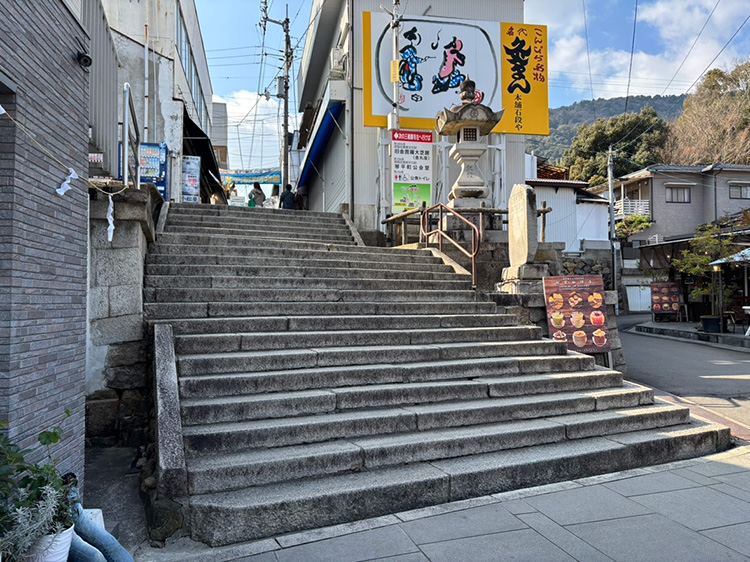
This area lined with gift shops and restaurants is called “Ichi no Saka.” For centuries, vendors have set up shop around these steps to sell refreshments and souvenirs to visiting pilgrims. Some of these shops sell Kamiyo Ame, Konpira-san’s most famous sweet. These hard, fan-shaped candies are flavored with yuzu citrus. The candy is considered lucky, and each package comes with a small hammer for breaking the candy into smaller pieces so that the good fortune can be shared.
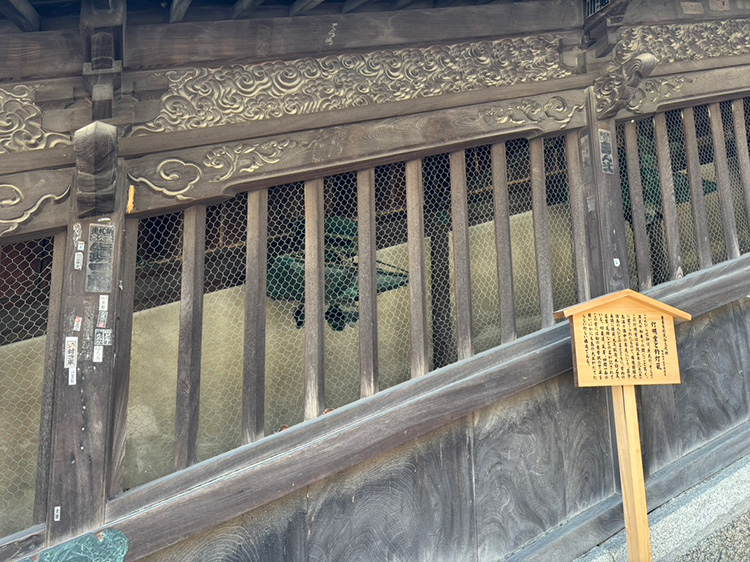
To the left of the path is a wooden structure that looks like a covered walkway. Rows of lanterns have been hung inside it to light the path at night. This structure was donated in 1858 by a group of tradespeople, including carpenters, woodworkers, stonemasons, plasterers, and roofers who lived on the other side of the Seto Inland Sea. A plaque lists the names of the donors. The structure was built by master carpenters using traditional Japanese joinery to assemble a framework without using nails. Their skill is seen in how tightly the joints fit together, despite the uneven ground along these steps. It was built using timber from the hull of a ship, reflecting the shrine’s broader association with mariners and the sea.
From this structure, there are 617 steps to the Main Shrine. The next segment will play at the upcoming rest area.
Statue of Kotooka Hirotsune
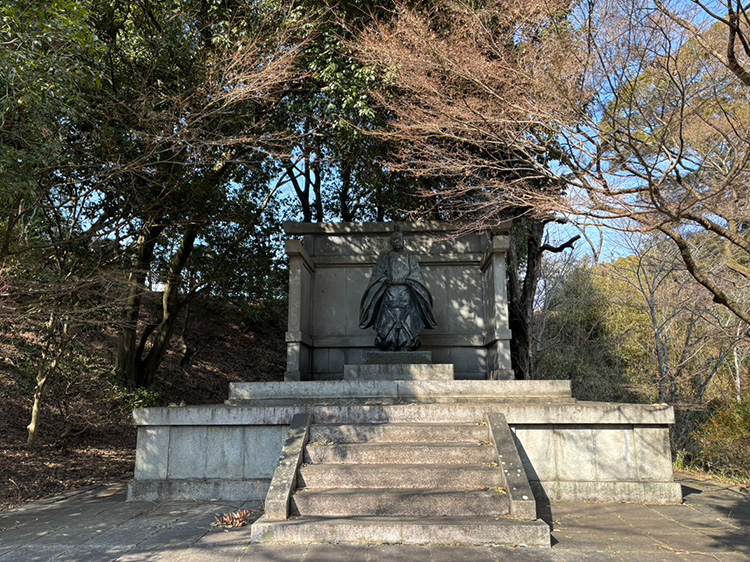
To the right of the path is a small clearing with a rest area. This space honors Kotooka Hirotsune, Konpira-san’s nineteenth head priest, who lived from 1840 to 1892. In the latter 1800s, Japan signed trade agreements with several Western countries, and its sea lanes became crowded with foreign vessels. After a series of deadly shipwrecks, Hirotsune founded the Imperial Marine Rescue Association in 1889. The organization has since been renamed Marine Rescue Japan, and it is still active today. A bronze statue of Hirotsune on the far side of the clearing overlooks a display of nineteenth-century rescue equipment.
Members of Marine Rescue Japan make pilgrimages to this site to pay respects to Hirotsune, as do members of the Japan Coast Guard and other people engaged in maritime occupations.
From here, there are 497 steps to the Main Shrine. The next segment will play at the Main Gate.
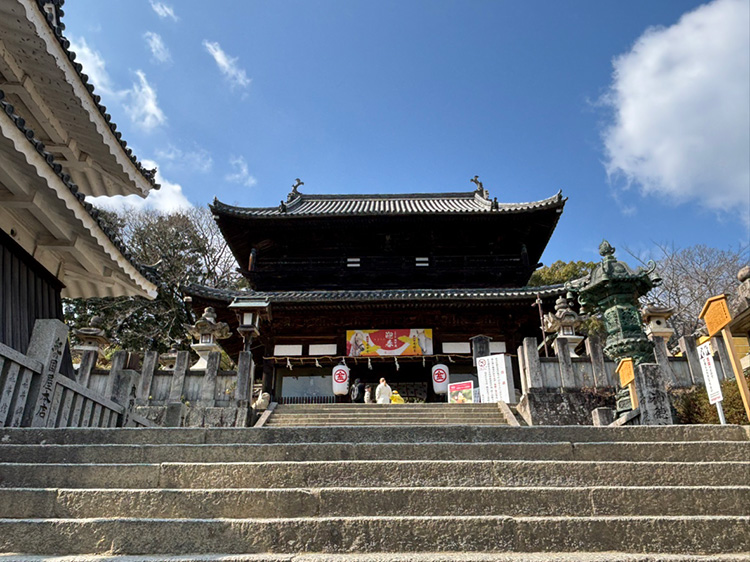
The Main Gate
The Main Gate marks the border of the sacred space of the kami. As is common at Shinto shrines, a straw rope called a shimenawa demarcates the boundary line. However, such ropes are not commonly hung on an elaborate two-story structure like this one. Konpira-san’s Main Gate is a Buddhist temple-style gate. It was built in 1649, a time when Buddhist deities were venerated here alongside Shinto kami. This gate is the first of several Buddhist structures found throughout the precincts. The shimenawa rope was added to the gate in the nineteenth century, when Konpira-san became an exclusively Shinto site.
Although the path up to the gate is lined with vendors, only five families are allowed to sell souvenirs within the sacred shrine grounds. Their carts are set up inside the Main Gate. These vendors are the descendants of the five families who started making Konpira-san’s famous Kamiyo Ame candy hundreds of years ago.
From the Main Gate, there are 420 steps to the Main Shrine. The next segment will play at the Treasure House.
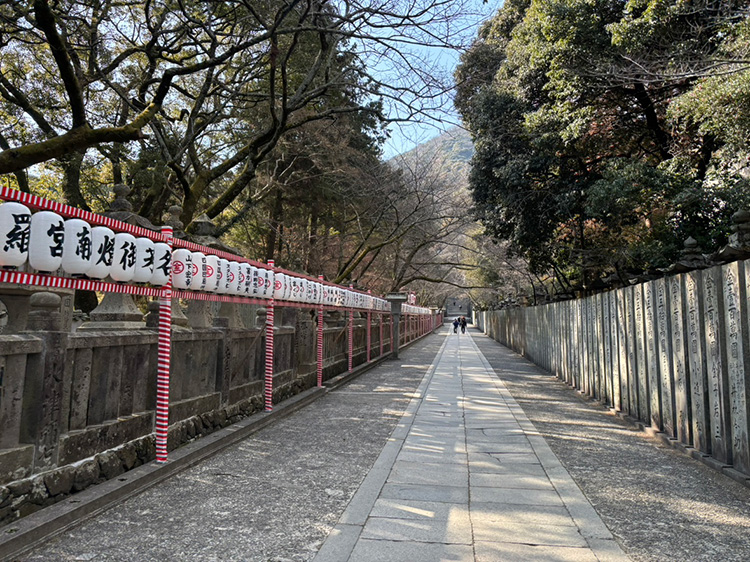
Sakura Baba
The 150-meter cobblestone path that extends from Konpira-san’s Main Gate is called “Sakura Baba.” Cherry trees along this path attract thousands of visitors each spring. In fact, the Treasure Hall’s eighteenth-century painting of the shrine grounds depicts characters in this area sipping sake and relaxing under the cherry blossoms.
Many engraved stone pillars and lanterns line the path alongside the cherry trees. Each of these monuments commemorates a major donation to the shrine and is engraved with details including the donor’s name, region, the amount given, and the date. Most of the pillars here are relatively new, but you will also pass much older stones, worn by age and covered with moss.
At the end of Sakura Baba, there will be more steps to climb. At the top, be on the lookout for a bronze statue of a dog.
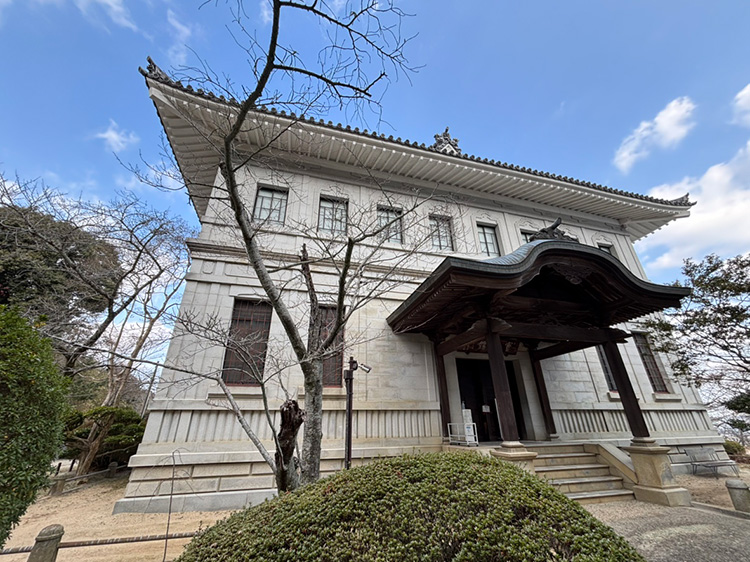
The Treasure House
To the right of the path is the Treasure House, where a wide variety of valuable artifacts, donated works of art, and other items are displayed.
The collection includes Buddhist statuary that once drew countless pilgrims. The most notable example is a wooden statue of Kannon, the bodhisattva of compassion. This statue used to be enshrined alongside the kami in the Main Shrine.
One of the Treasure Hall’s best-known items is an eighteenth-century painting of the approach to the shrine. The artwork shows the route in minute detail, with bustling crowds of different characters engaging in various activities. For example, some pilgrims are shown bathing to purify themselves in preparation for the climb.
Other exhibits display valuable items like suits of samurai armor and swords. Because Konpira-san is associated with seafaring, there are many items that relate to the sea, such as elaborate model boats that were donated by shipbuilders.
The Treasure House itself blends Japanese and Western architectural elements, like how the traditional gabled entryway is paired with a granite facade. It was designed by Kuru Masamichi and completed in 1905. Kuru’s design for the Japan Pavilion in the 1893 Chicago World’s Fair is said to have inspired famed architect Frank Lloyd Wright’s interest in Japanese architecture.
Please feel free to step inside the Treasure House. The audio guide will continue when you return to the pilgrimage route.
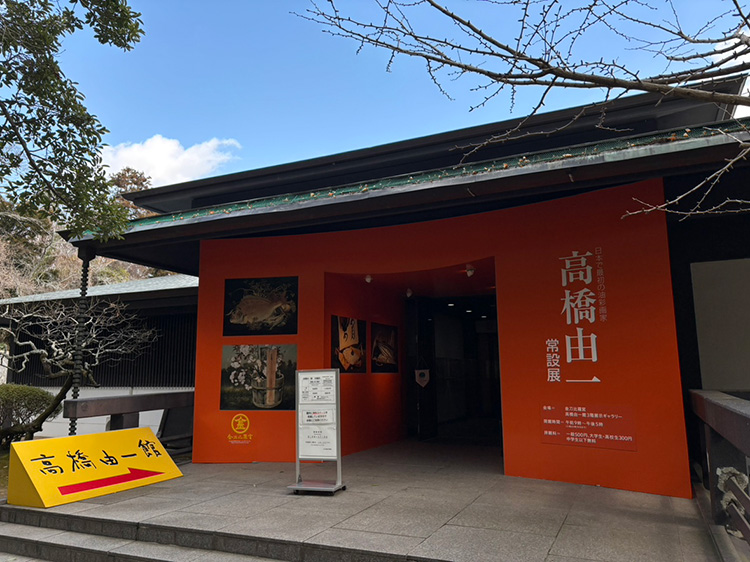
Takahashi Yuichi Museum
This museum displays a selection of oil paintings by Takahashi Yuichi. Takahashi was born in 1828. At the time, Japan had largely been closed to outside contact for nearly 200 years, so most people were not familiar with Western art. However, this started to change in Takahashi’s adulthood, when cultural influences from Europe and North America began to take root. After being exposed to new art forms, he took particular interest in oil painting. Traditional Japanese art tends to be more stylized, but Takahashi loved the realism that could be achieved with oil paints.
He went on to become a pioneer among Japanese artists working in the medium. Under the tutelage of artists who visited from abroad, he learned oil techniques and developed his skills. Takahashi also helped popularize oil painting among his countrymen by producing landscapes and still lifes that featured familiar subjects, such as famous places in Japan and everyday items like cured fish and tofu.
Takahashi stayed in the town of Kotohira from 1880 to 1881, during which time he painted portraits of the shrine’s head priests and captured local scenery in works like Distant View of Mt. Kotohira. The shrine now owns 27 of his paintings. Please feel free to step inside for a look before continuing on your pilgrimage.
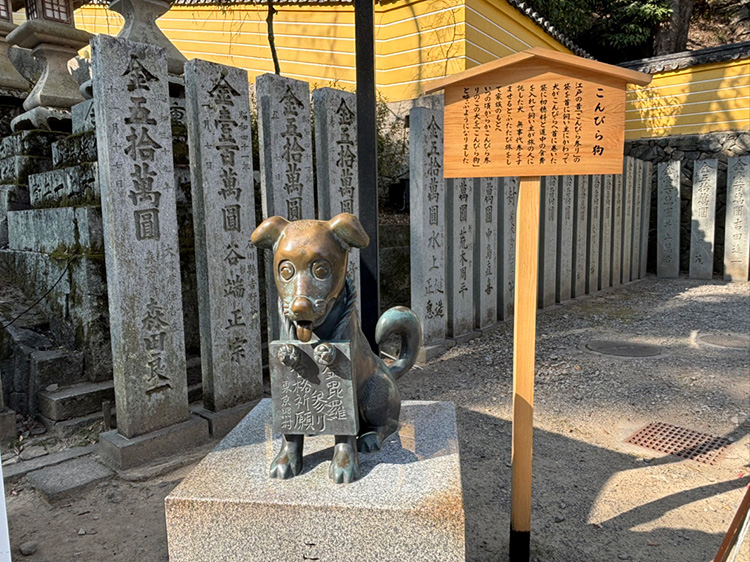
Statue of a Konpira Dog
A bronze statue of a Konpira dog sits waiting at the bottom of a flight of steps. The illustrator Yumura Teruhiko provided the endearing, cartoonish design that was used to commemorate these loyal canines. Konpira dogs were four-legged pilgrims sent to make donations on behalf of those who could not travel to the shrine themselves. The dog’s owner would write the name of the shrine and their home address on its collar and attach a bag of money for expenses and a donation to the shrine. Konpira dogs traveled with other pilgrims, and after delivering their donations, the dogs would be passed from traveler to traveler until they were returned home.
The dog in Yumura’s statue is named “Gon.” The sign around its neck reads, “On pilgrimage to Kotohira, praying to pass exams.” This suggests the faithful dog was journeying on behalf of a student too busy to leave their desk. The Konpira dogs are also immortalized on protective amulets, votive tablets, and souvenirs offered by the shrine.
Given this unique history, Konpira-san is a dog-friendly shrine. Dogs are welcome on the shrine grounds if they are kept on a leash, but they are not permitted inside the buildings.
There is a lot to see around this clearing, so before ascending the stairs, please take a look around. The next audio segments will play by the Takahashi Yuichi Museum and a stable for sacred horses, both of which are located in this area. The next site after these two points of interest will be at the top of these steps.
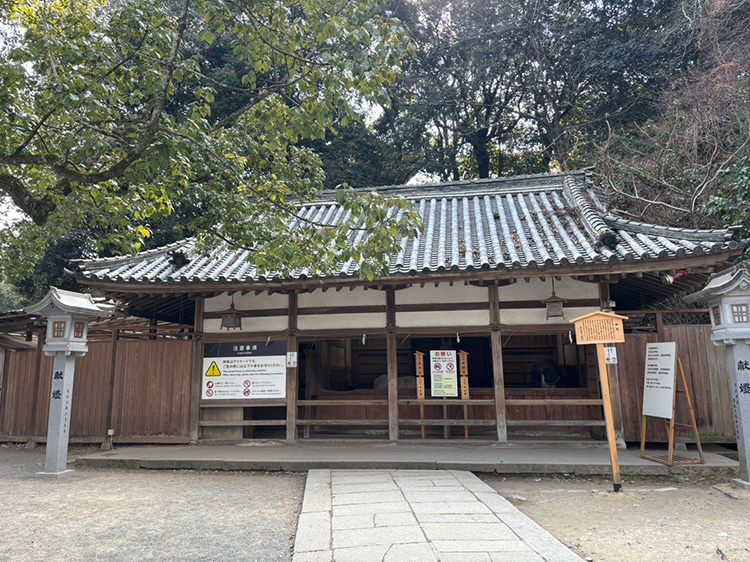
Sacred Horses
Konpira-san’s sacred horses, or shinme, are stabled here. Sacred horses are kept solely for use by Shinto kami. When a deity is ceremoniously transferred to another location, the horse is fitted with a saddle, upon which the kami is said to ride. No human ever sits in the saddle of a sacred horse.
Although the practice used to be more common, Konpira-san is one of only a few shrines that still keep sacred horses. No single breed is considered sacred, and they are instead selected from among horses donated to the shrine. The custom of donating a horse goes back some 1,300 years and typically marked a significant event or accompanied an important prayer.
In later periods, devotees started to offer horse figurines or other images in lieu of real horses. This led to the now widespread practice of offering votive wooden plaques called ema, which means “painted horse.” Votive plaques with horses and other designs are now available at many shrines, including Konpira-san.
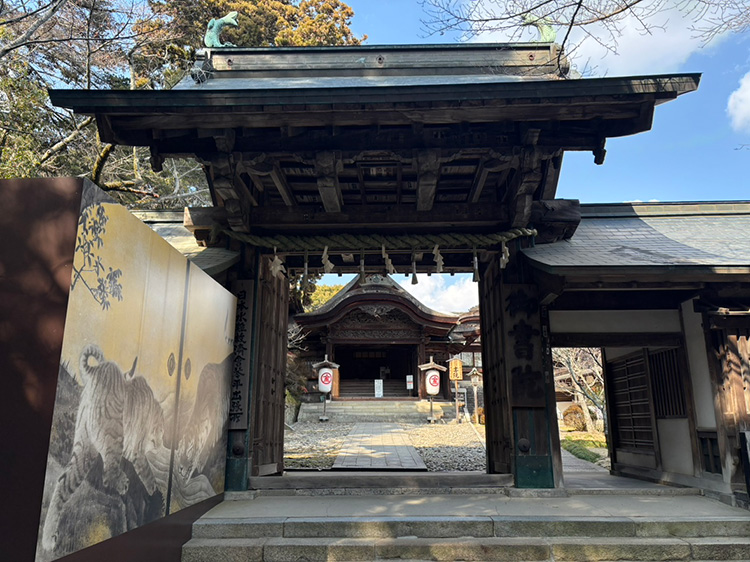
The Shoin Reception Halls
Some of Konpira-san’s most famous artworks are housed in the upcoming complex on the right-hand side of the pilgrimage route. This complex comprises three interconnected buildings called Omote Shoin, Oku Shoin, and Shiro Shoin. Built in the seventeenth and nineteenth centuries, they served as reception halls and living quarters for the head priests.
Only Omote Shoin is regularly open to the public. Its walls and sliding doors are painted with masterful artworks specifically designed to suit each room and blend in with the surrounding scenery. For example, one room is painted with a river and waterfall that act as natural extensions of the pond outside.
The creators of these art pieces are known for their elaborate work. At the entrance, a painting by Mori Kansai features a fierce eagle against a gold background. In the rear rooms, Murata Tanryō painted a dynamic scene of dozens of hunters on horseback and a misty view of Mt. Fuji. The middle rooms were painted by Maruyama Ōkyo, an eighteenth-century artist who pioneered a more naturalistic style. For example, in the Crane Room, Ōkyo painted two different native species of crane in careful detail, accurately capturing the characteristics of both species. Ōkyo’s realistic depictions only falter in the Tiger Room, where the predators around the room are unexpectedly round and chubby. Having no live tiger specimens to observe, Ōkyo had to base his portrayal on housecats.
An outdoor space at Omote Shoin is occasionally used for a ritual called kemari. This is an activity that resembles hacky sack performed with a ball. The pitch is marked by four forked trees of different species, where kami are believed to sit while they watch the ritual.
Please feel free to spend some time visiting Omote Shoin. From here, there are 308 steps to the Main Shrine. The next audio segment will play at a café where you can take a break and have lunch.
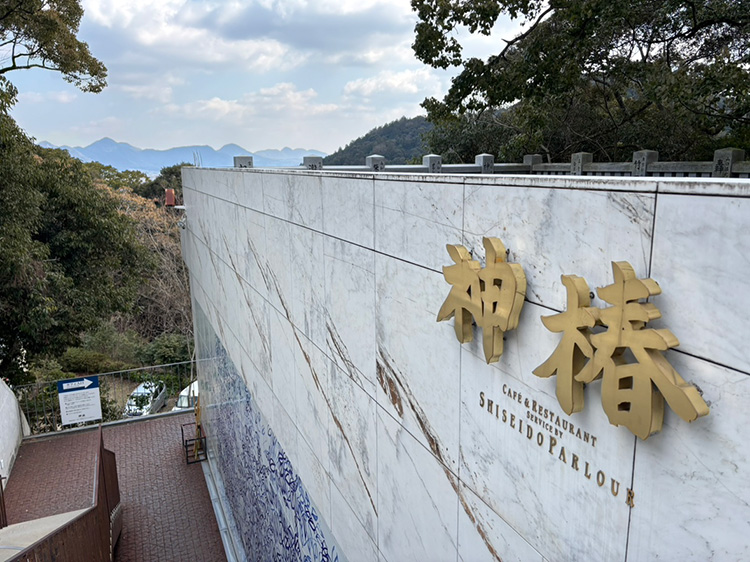
Kamitsubaki Café and Restaurant
Visitors to Konpira-san often stopped to rest here during the climb up the pilgrimage route. A teahouse was first built for them in 1797. Its current, more modern iteration is a café called Kamitsubaki that opened in 2007. The menu is an array of light meals and artful desserts that are inspired by French cuisine and made with locally sourced ingredients. The dining facilities are built below ground level on the side of a slope, which allows for spacious views both from the pilgrimage route and the café. The bustling indoor space is bright and airy, and the windows overlook a lush forest that is home to many tiny orange-and-black birds called yamagara. It is a memorable spot for many visitors to the shrine, as well as a place frequented by local patrons.
From the café, there are 285 steps to the Main Shrine. The next site is Asahi-sha, one of the shrine’s largest buildings.
Asahi-sha
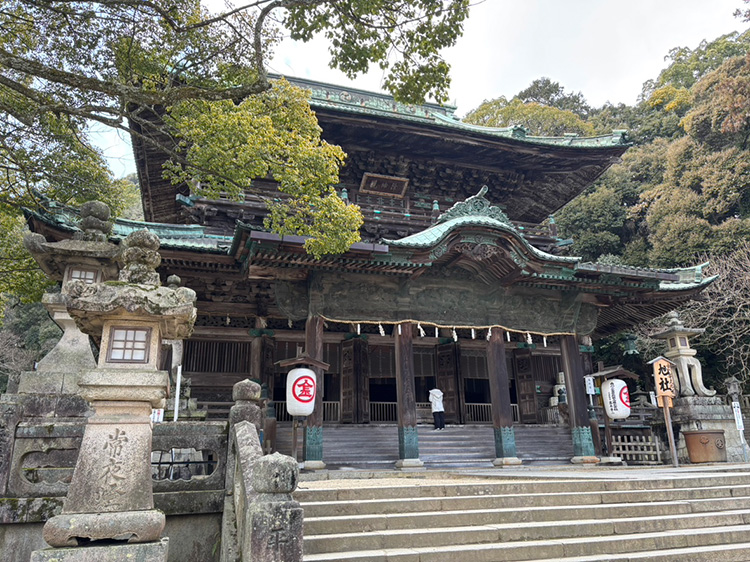
The elaborately decorated building just ahead is Asahi no Yashiro, more commonly known as Asahi-sha. It stands 25 meters tall, and because of its grandeur, many pilgrims have initially mistaken this subsidiary shrine for the goal at the end of their journey.
Asahi-sha originally enshrined a large Buddhist statue. The hall took 40 years to build and was finally finished in 1845. However, within a few decades of its completion, Konpira-san became exclusively Shinto, and many Buddhist elements were removed. Instead of being demolished, Asahi-sha was converted to a Shinto shrine. It now hosts a multitude of deities, including Ame-no-Minakanushi, who is considered one of the first kami in the Shinto pantheon.
Nearly the entire exterior of the building is ornately carved. For example, a whirling cloud design spreads across the underside of the eaves. On the tail rafters and walls, there are carvings of animals, both real and mythological. Many of them are auspicious symbols, like the crane and turtle on opposite gables that together represent longevity. Others, like the fish on some of the side panels, may have been included as water-related imagery to symbolically protect the wooden building against fire.
The first floor is a large, open worship chamber. There are no central pillars to support the massive weight of the wooden roof and its 10,000 copper tiles. That weight is distributed by a clever cantilevering system concealed in the upper floors.
From Asahi-sha, there are 157 steps to the Main Shrine. The next audio segment will play at the Sakakimon Gate.
Please note that Asahi-sha is currently undergoing a major restoration project to repair moisture and termite damage. It is scheduled to reopen in 2043.
Sakakimon Gate
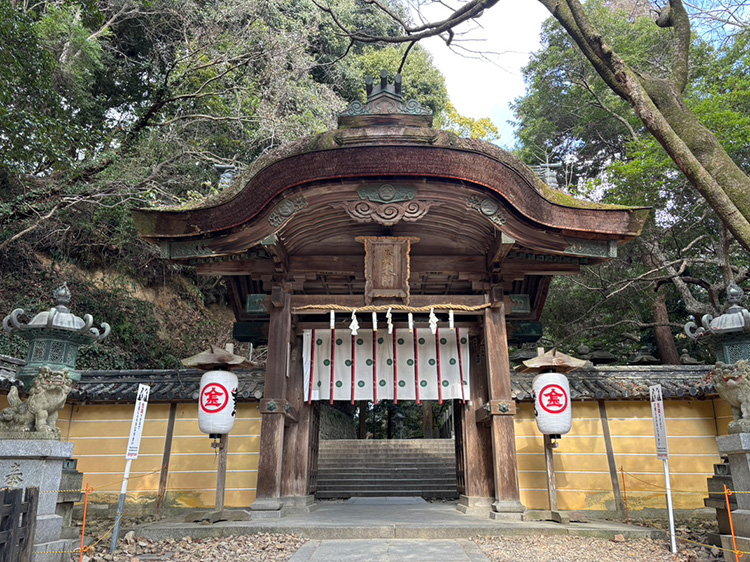
The upcoming structure with an elegant, undulating roof is an example of a karamon gate, the most formal kind of gate used at shrines and temples. This one was commissioned by a local daimyo lord in the sixteenth century. During construction, one of the pillars was mistakenly placed upside down. This accident inspired the name “Sakakimon,” which means “Gate with an Upside-Down Pillar.” When the gate was repaired in 1879, its name was accordingly changed by replacing the written character for “upside down” with the one for “wisdom.” Although it is now written differently, the gate’s name is still pronounced the same way.
From this gate, there are 143 steps to the Main Shrine. Just a little farther to go, but there are still more sites to learn about on the way.
The Subtracted Step
The steps thus far have gradually led up toward the Main Shrine, but ahead there is a single step down. This extra step seems to have been purposefully added to avoid an unlucky number. When the path to the Main Shrine was first constructed, there were 786 steps. In Japanese, the numbers 7, 8, and 6 can be read as na ya mu, the word for “worry.” The extra step down may have been included to avoid this unlucky association, making the final number of stairs 786 upward steps minus one downward step. That way, it is said that there are 785 steps.
From here, there are only a few flights of steps left to climb before reaching the Main Shrine.
Ritual Water Basin
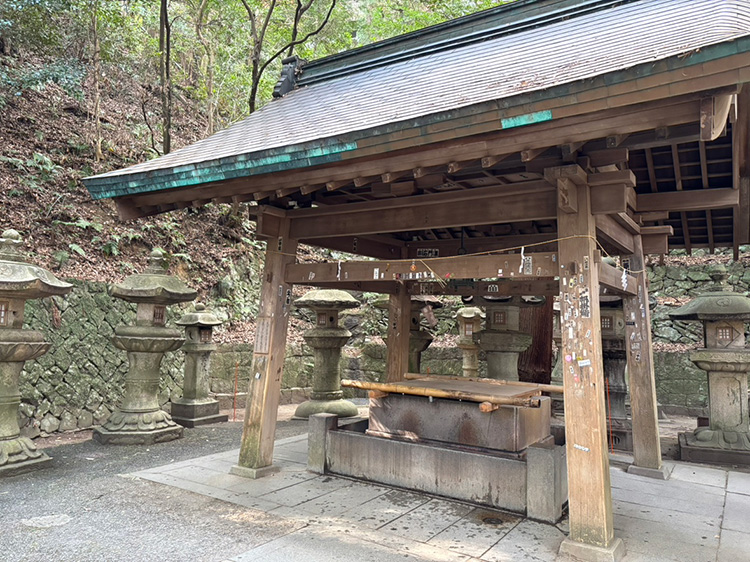
At Shinto shrines, visitors are encouraged to purify their hands and mouths with sacred water before approaching the main shrine buildings. The water basin for this purpose was previously located north of the Main Shrine, but it was moved to this location when the observation deck was constructed in 1930.
You are almost ready to greet the kami at the Main Shrine! There is one more flight of stairs to go.
The Steepest Steps
The final 133 steps to the Main Shrine are the steepest. There are two small shrines midway up the final staircase. One shrine is dedicated to a kami associated with success in business, and the other enshrines a kami that protects crops. These are the last subsidiary shrines before the Main Shrine.
At the top of the stairs, the Main Shrine is straight ahead. The path to the left leads down the mountain. To the right, there is an observation deck. The path beyond the observation deck continues up to the rear shrine, a subsidiary shrine associated with mythological mountain beings called tengu.
The audio guide will continue playing when you reach the sites at the top of these steps, including the Main Shrine. You’re almost there!
Main Shrine
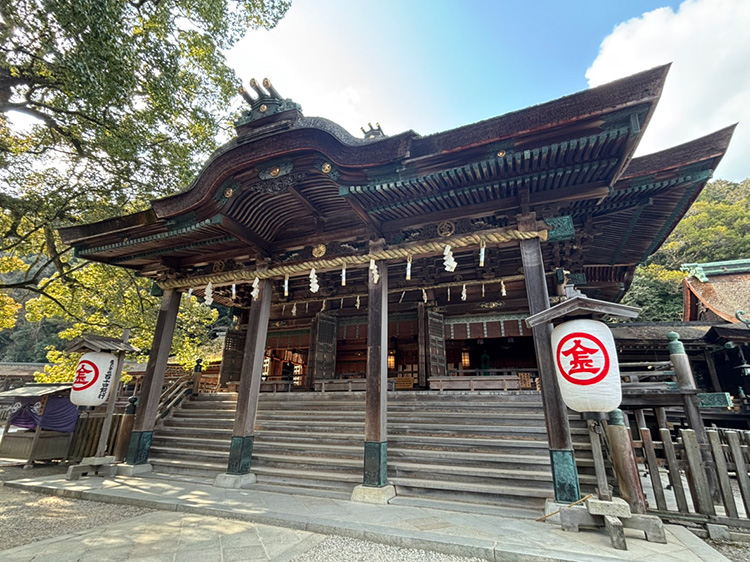
Welcome to the Main Shrine. For centuries, pilgrims have journeyed to reach this revered site.
A shrine is said to have stood at this cliffside location for at least 3,000 years. The current structure dates to 1878, a period of rapid change and modernization in Japan. Until that time, many religious sites combined elements of Shinto and Buddhism, but when the government enacted policies separating the two, Konpira-san became exclusively Shinto. The Main Shrine was rebuilt in a Shinto architectural style that included elements that felt fresh and new at the time, suggesting that the shrine leaders sought a clean break with the past. Instead of décor with elaborate carvings and brightly colored paint, they chose elegant cast-copper fittings with a vining pattern that repeats throughout the structure. Under the eaves, the logs in the supportive brackets are cut with sharp corners rather than rounded edges. Although the cypress used throughout the structure has darkened with age, originally it would have looked almost white, representing purity. The roof is a classic element, with shingles made of thickly layered cypress bark that is replaced every 33 years.
Many earlier structures built throughout the shrine grounds had animal motifs, but this building is adorned with plants. In particular, cherry trees. Inside the main chamber, the ceiling is decorated with cherry blossoms rendered in Urushi lacquer that was sprinkled with precious metals for depth and shine. Lacquer is also used to depict blooming cherry trees on the exterior walls.
This building enshrines two kami. One of them is Ōmononushi-no-Kami, a deity who has dominion over many natural forces. Seafarers in particular have sought this deity’s protection. The other enshrined deity is Emperor Sutoku, who was exiled to this region in the twelfth century after he led a failed rebellion. After the exiled emperor died, it is said he became a vengeful spirit who caused many natural disasters. Sutoku’s spirit was finally pacified when he was named a guardian deity of Japan. Emperor Sutoku is also honored another 138 steps up the mountain, at a subsidiary shrine called Shiramine Jinja.
A covered walkway to the left of the Main Shrine connects it to a subsidiary shrine that temporarily houses the primary deities during repairs to the Main Shrine. When Konpira-san used to enshrine Buddhist deities, this subsidiary shrine was a temple to Kannon, the bodhisattva of compassion. It now enshrines a Shinto kami named Mihotsuhime-no-Mikoto, who is a consort of Ōmononushi.
A visit to the Main Shrine is the pinnacle of the Konpira-san pilgrimage. However, if you would like to continue up the steps to see more subsidiary shrines, the next audio segments will play at the Observation Deck and Shiramine Jinja.
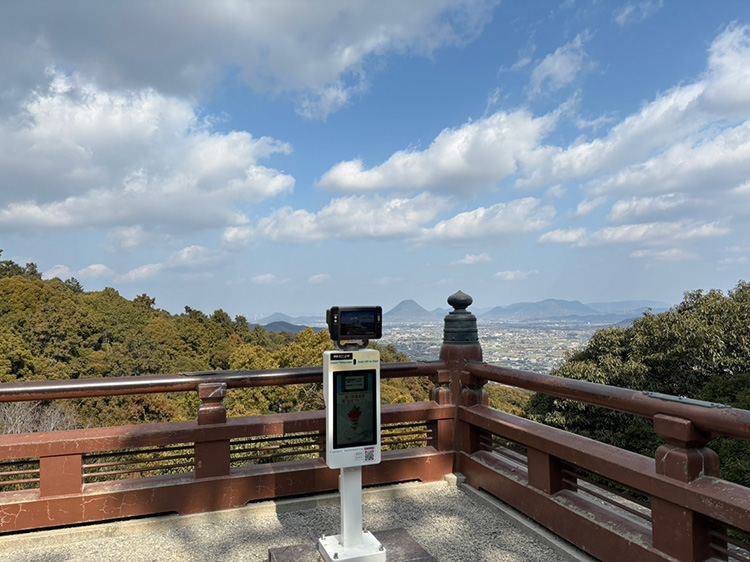
Observation Deck
This observation deck faces northeast, toward the Seto Inland Sea. You can see beyond the rice fields and towns of the Sanuki Plain to the sharp cone of Mt. Iino. It is often called “The Fuji of Sanuki” after Japan’s tallest and most famous mountain.
Although it is impossible to tell while standing on the concrete platform, the natural cliff face is actually very close to the Main Shrine. This did not provide much room for crowds of pilgrims or people trying to maneuver around them and continue up to the rear shrine. In 1930, this platform was built around the narrow edge of the cliff.
There are another 583 steps between here and the rear shrine. This audio guide will continue as you reach another subsidiary shrine along the wooded path.
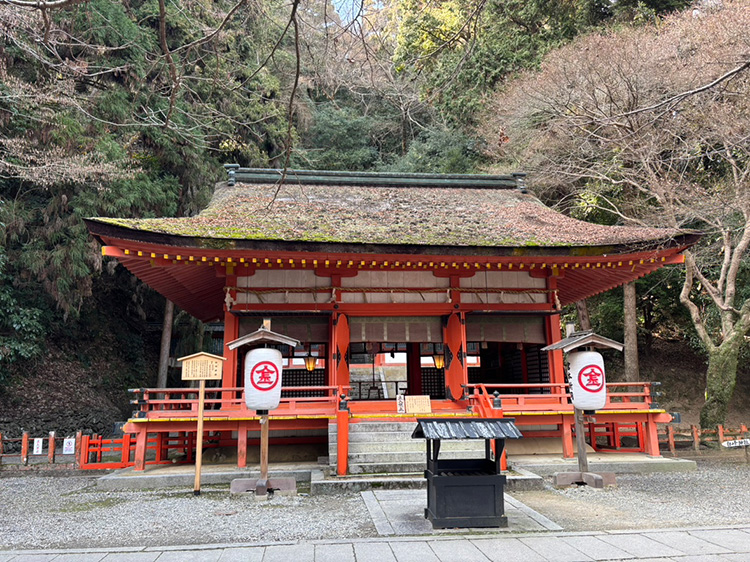
Shiramine Jinja Shrine
This building dates to 1913 and enshrines Emperor Sutoku, a twelfth-century figure who was a victim of power struggles. According to legend, Sutoku’s angry spirit tormented Japan’s imperial family for centuries before he was deified as a Shinto kami.
Sutoku reigned from 1123 until 1141, when he was pressured to abdicate. Years later, he attempted to reclaim power in a coup. He failed, and he was exiled from the capital of Kyoto to Shiramine, the town here in Kagawa that gives this shrine its name.
In exile, Sutoku devoted himself to Buddhism and spent years copying some 190 volumes of sutras. He wanted to have his sutras enshrined in Kyoto, but the reigning emperor refused, believing they contained a curse. Sutoku was outraged.
After his death, the Great Hall of State burned down, killing several members of the court. For centuries, disasters and conflicts often happened around the anniversary of Sutoku’s death, and the legend of his vengeful spirit grew. In 1868, Emperor Meiji pacified Sutoku’s spirit by having him enshrined in Kyoto as a guardian deity of the country. Konpira-san’s Shiramine Jinja is one of many sites in Kagawa Prefecture dedicated to Sutoku.
The building’s red-and-white color scheme is typical among Shinto shrines. Traditionally, the red paint contained cinnabar, an ore that imbued a rich red color and helped protect the wood from pests and decay. It was also believed to ward off evil. White is associated with purity and the divine.
From Shiramine Jinja, there are 445 steps to the rear shrine.
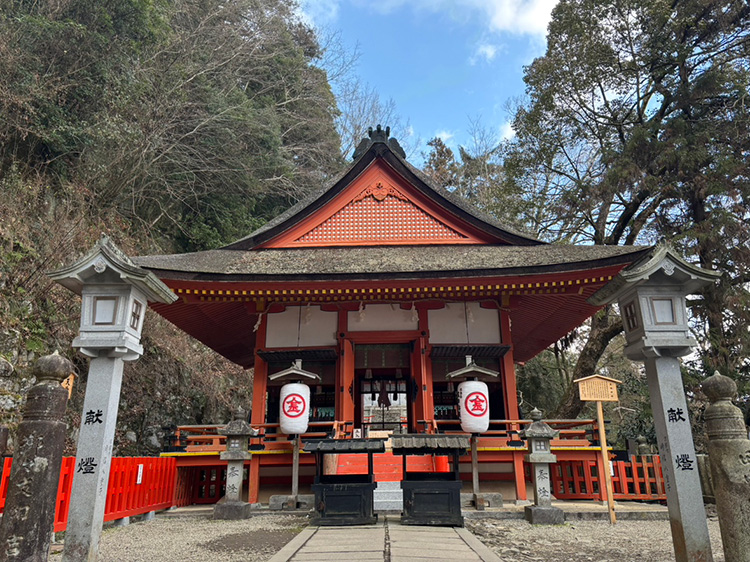
Izutama Jinja Shrine
Congratulations! You have made it to the highest spot on the Konpira-san shrine grounds. This is Izutama Jinja Shrine, known also as the rear shrine.
The kami enshrined here is Izutamahiko-no-Mikoto, the deified spirit of a sixteenth-century head priest of Konpira-san. In life, he declared he would protect his beloved Konpira-san even after his death. According to legend, he transformed himself into a tengu, a powerful mythological being said to live in the mountains. Tengu are often depicted with wings and birdlike faces or long red noses. Two tengu masks, representing both kinds of tengu faces, hang high on the cliff wall to the left of the shrine.
Most shrines face east, toward the rising sun, but this shrine faces south, toward the Main Shrine of Konpira-san. This reflects Izutamahiko’s promise to watch over his beloved shrine forever.
This brings us to the end of our climb. We hope you found the audio tour enlightening. Please take care on the way down and enjoy revisiting the many sites along the way.
Other audio guide content
Links


令和7年度文化財多言語解説整備事業